
Dashboard design for the UK's fastest-growing start-up
- Client
- Allica Bank
- Role
- Senior Product Designer
- Year
- 2022
- Tags
- Desktop, Research, UX, UI
A dashboard that fell short for SMBs
The MVP provided only a balance snapshot, leaving business owners without the tools they needed to manage finances day-to-day.
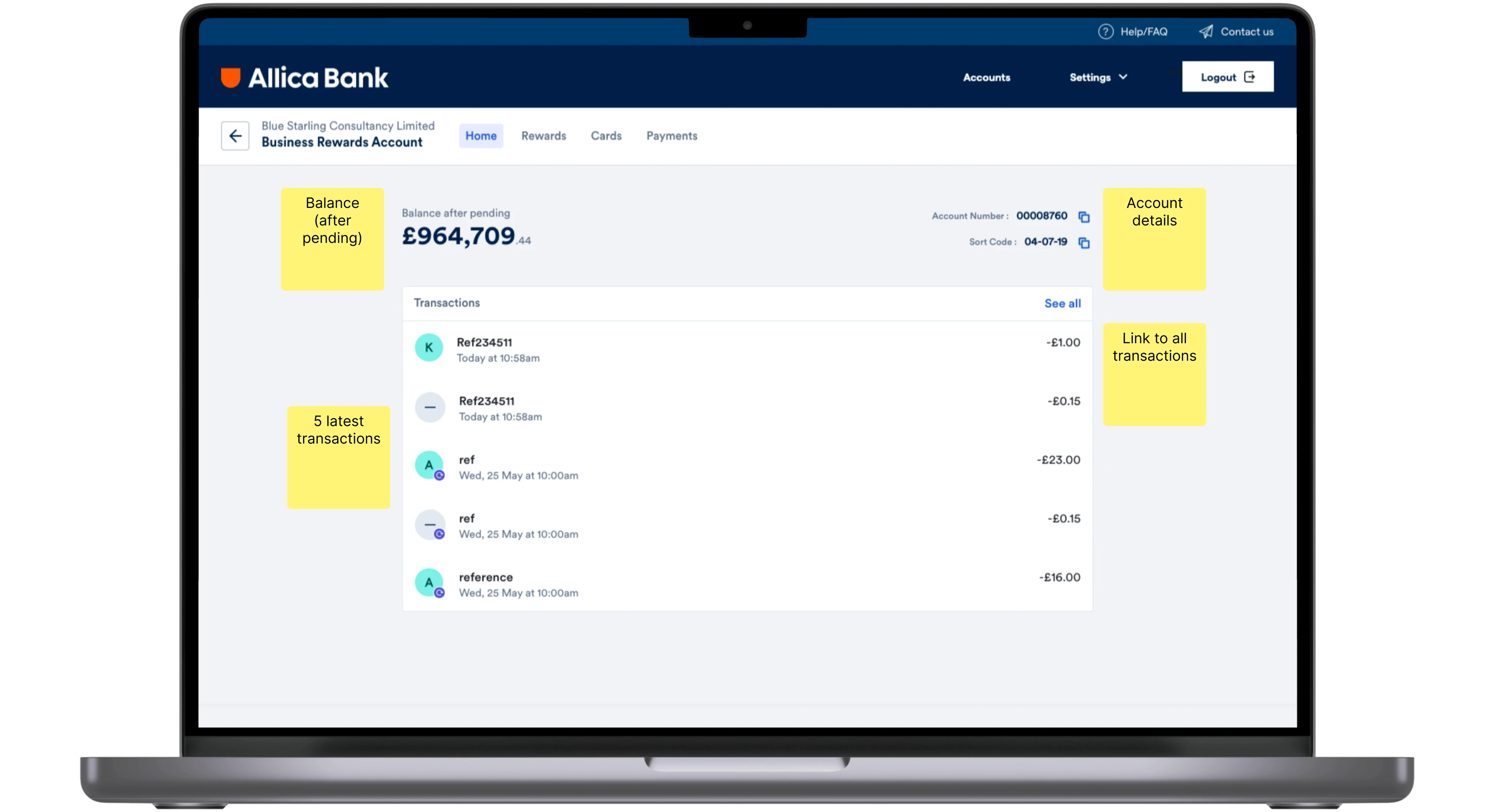
Barriers to delivering value
The MVP delivered only the basics and we lacked insight into how customers used it. To progress, we first had to research SMB needs and translate those findings into design decisions that would create real value.
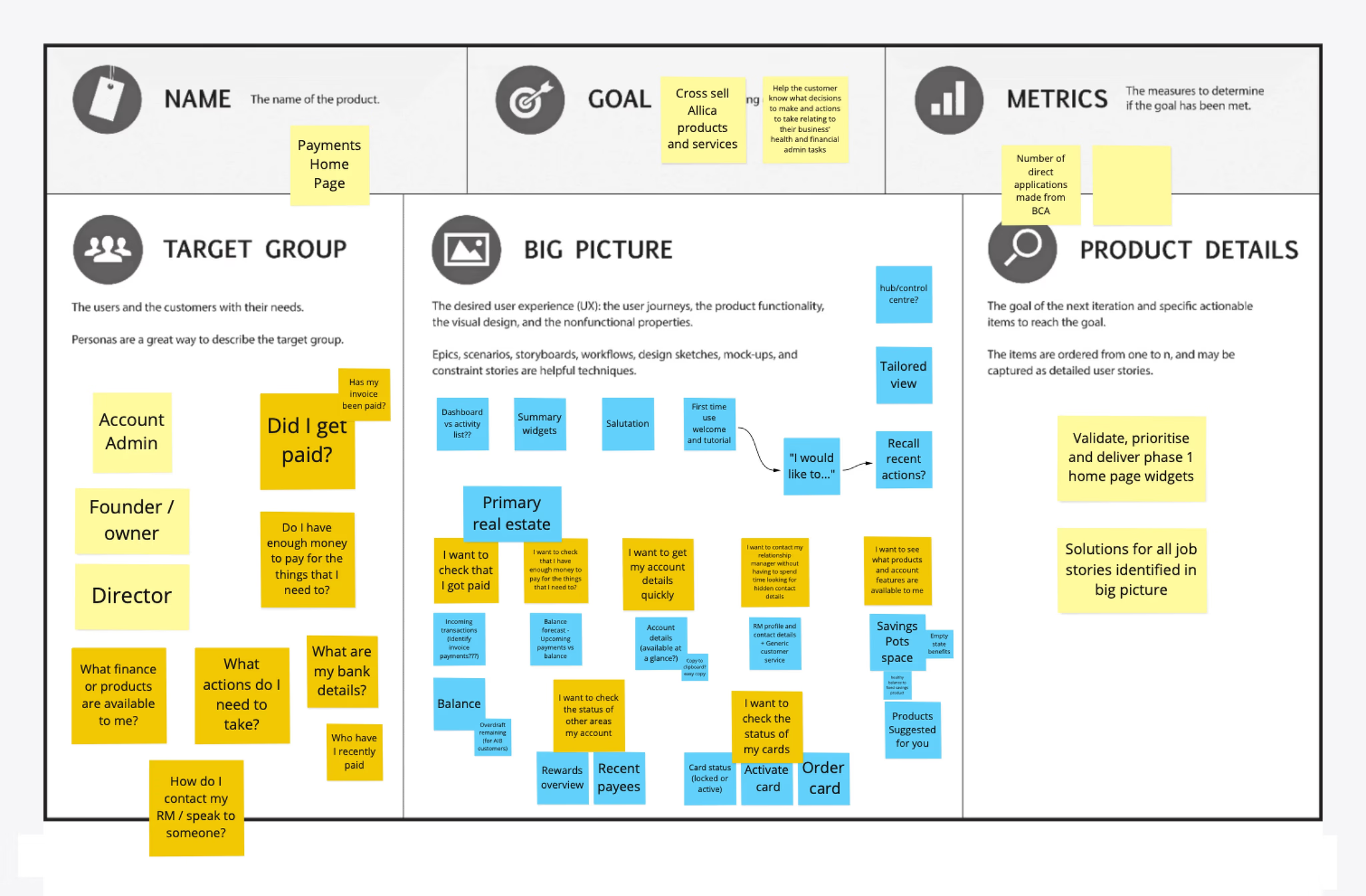
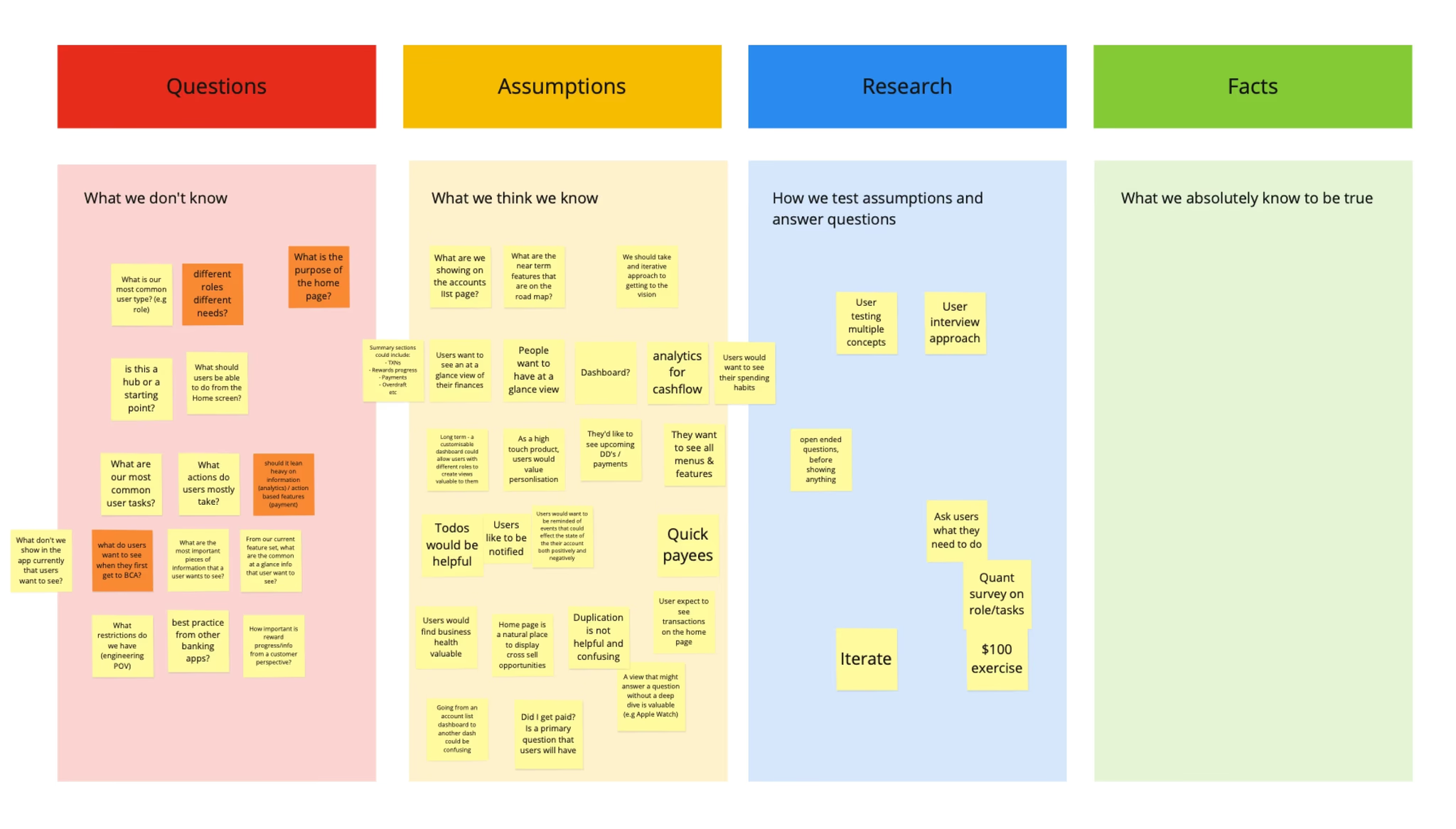
Questions, conversations and validating ideas
Starting with the right questions
The project began with a series of collaborative workshops, involving myself, a project manager and an engineer.
Digging into customer needs
To ensure the redesign was grounded in real customer needs, I conducted interviews and tested early concepts with small and medium-sized business owners. Each session was structured into three parts:
What we want to discover
The research was designed to uncover how business owners interact with their current account dashboard (BCA) and to validate early design concepts. Specific goals included:
- Identify what information users find most valuable when first logging in.
- Understand the scenarios in which participants open their BCA, the questions they want to answer and the decisions they hope to make.
- Discover what participants like and what they would improve about their current BCA home page.
- Ask participants to prioritise features from the proposed design concept.
- Learn the most common actions users want to take when they log in.
- Test hypotheses and assumptions related to the new home page design concept.
Testing ideas, validating assumptions
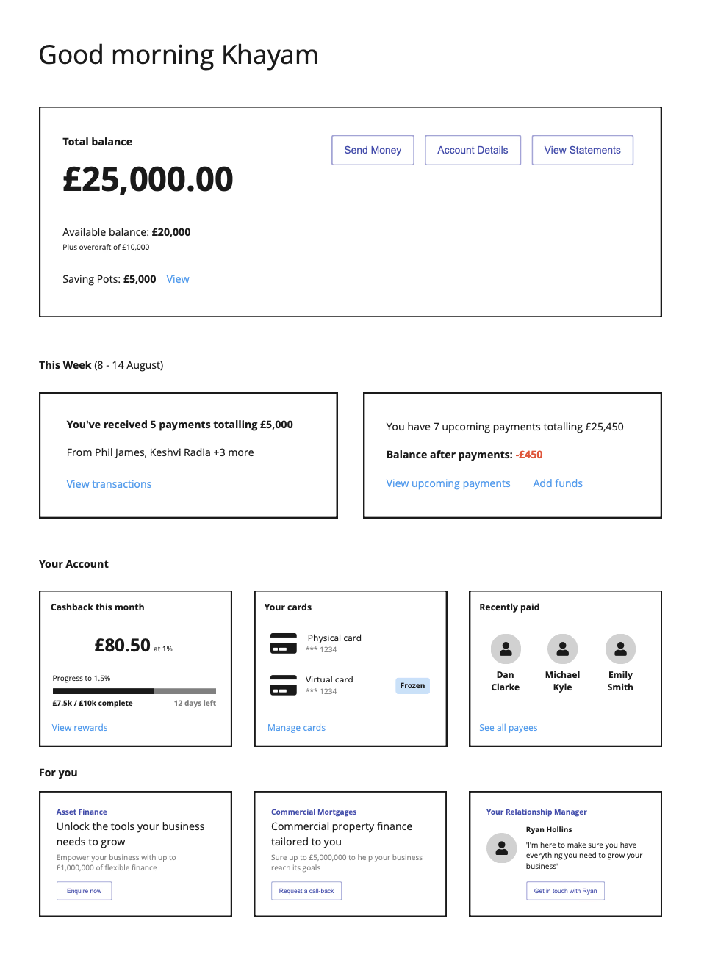
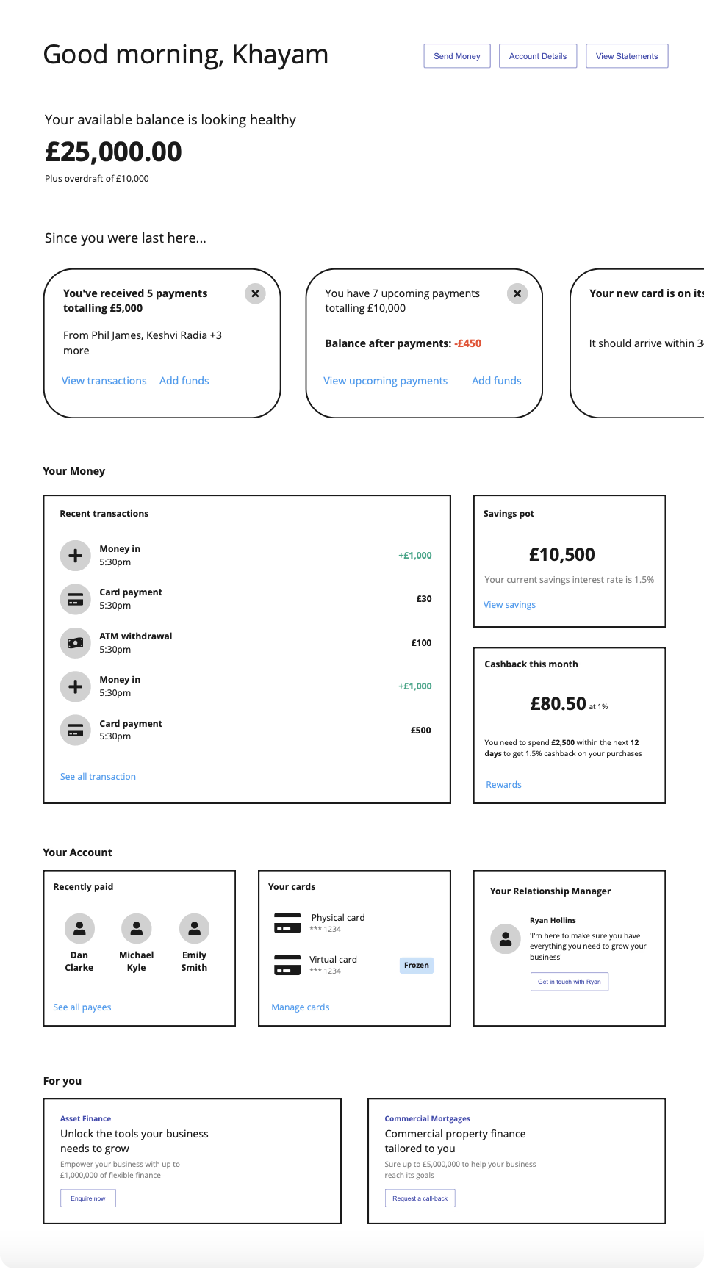
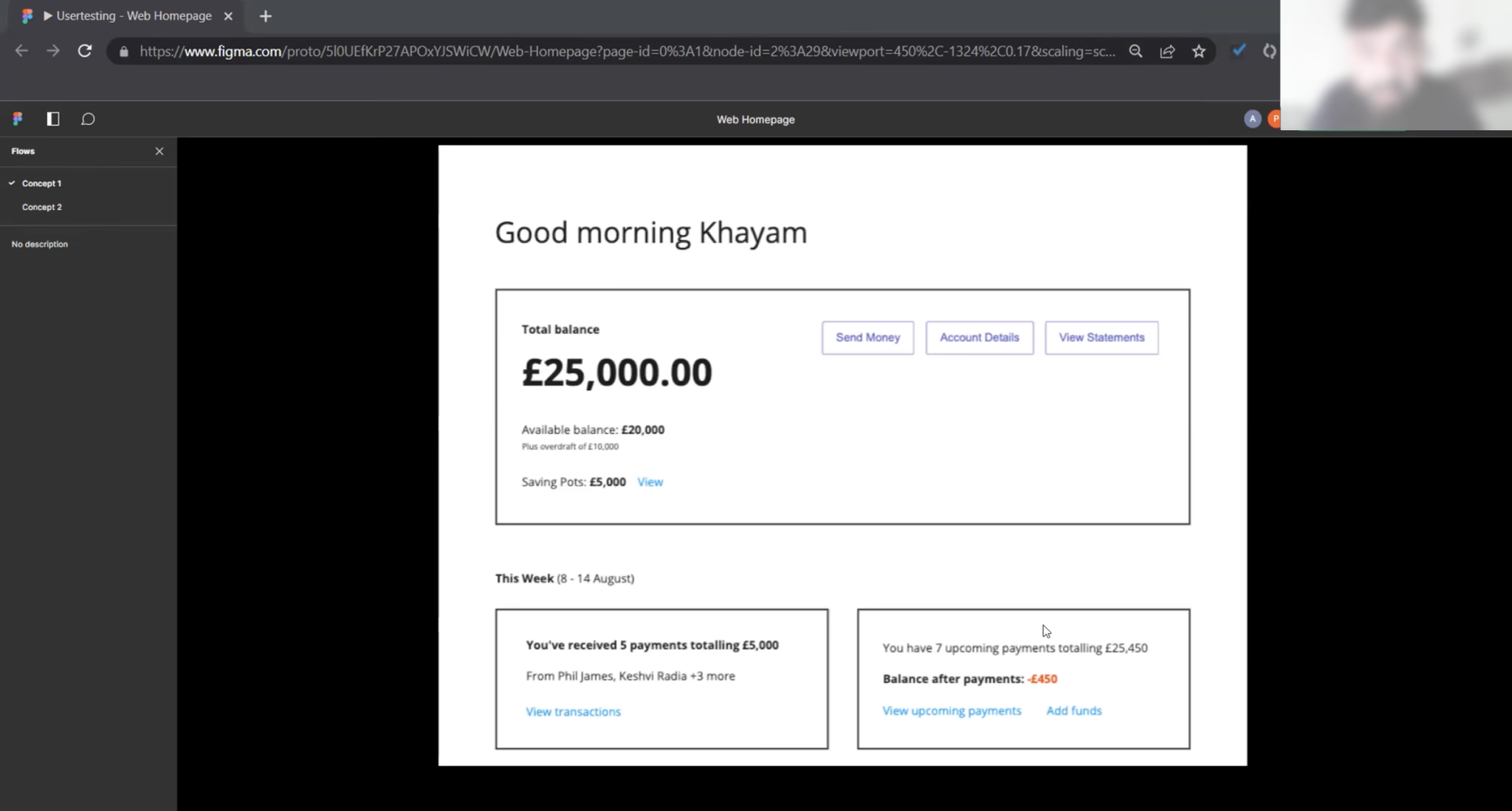
As part of discovery we created low-fidelity designs to use in a concept testing exercise with participants. Based on competitor analysis and our hypotheses we developed two concepts that shared some similarities but also key differences, allowing us to compare approaches and validate assumptions.
The results helped us identify which design directions resonated most with users and where we needed to refine our ideas.
Concept 1
- Salutation
- Total balance showing available balance, overdraft and savings pot balance
- Payments in widget
- Upcoming payments widget
- Your account section featuring cashback, cards and recently paid
- For you
Concept 2
- Salutation
- Available balance paired with available overdraft balance
- Notification cards
- Your money section: recent transactions, savings pot and cashback
- Your account section: recently paid, your cards and your relationship manager
- For you
Where are you putting your money?
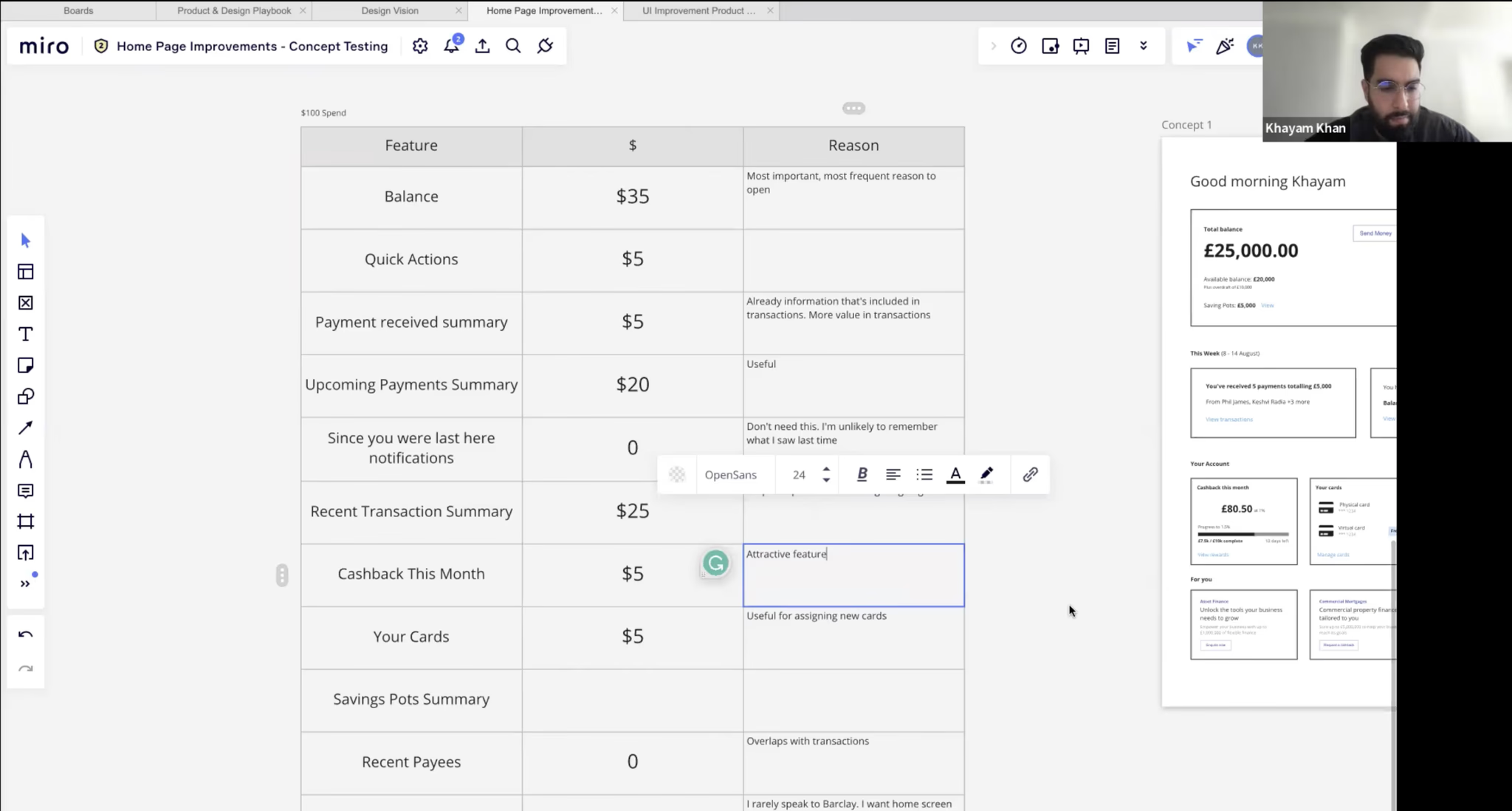
As part of the interviews we asked participants to imagine they had $100 to spend on the features shown during concept testing and decide how they would allocate it.
The more valuable a feature was, the more money they assigned to it. Participants were not required to spend money on every feature, only the ones they felt were most important. To make the exercise easier, we used increments of $5 or $10.
Setting the design direction
Based on the interviews and exercises we identified five key insights.
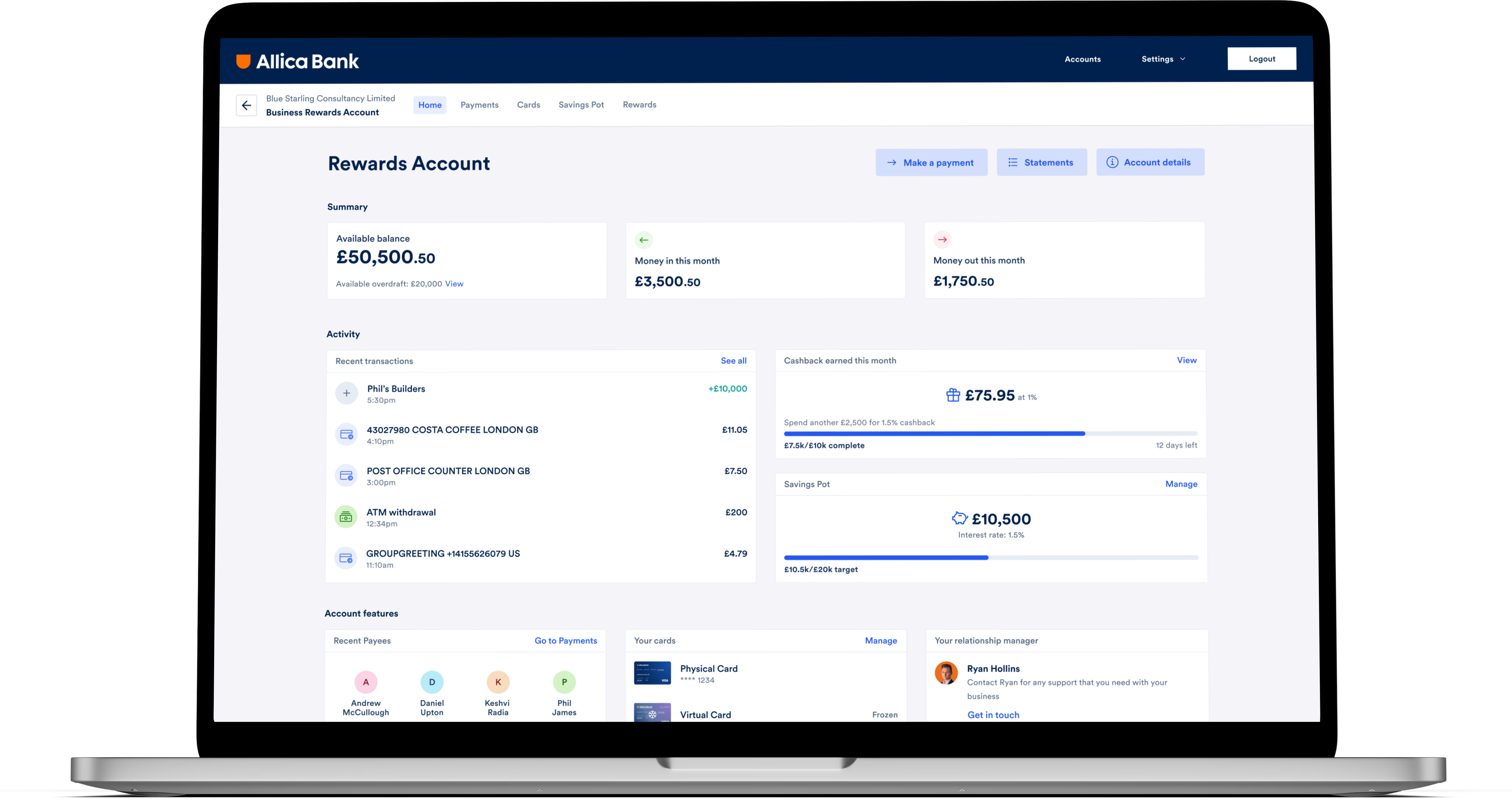
Your business at a glance
From the insights we gathered it was clear that some of the suggested features were technically advanced and better suited to the long-term vision for the dashboard.
For the first iteration we chose to simplify the scope and focus on delivering an achievable short-term solution that still added meaningful value.
Balance and cashflow at a glance



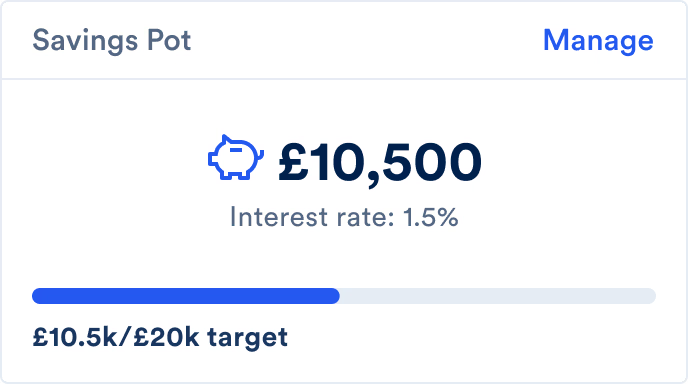
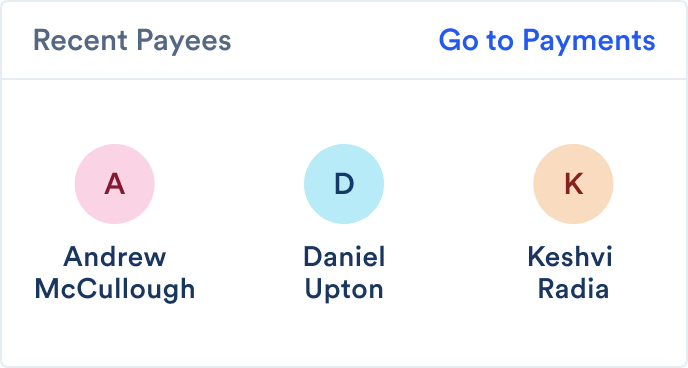
Shortcuts within widgets
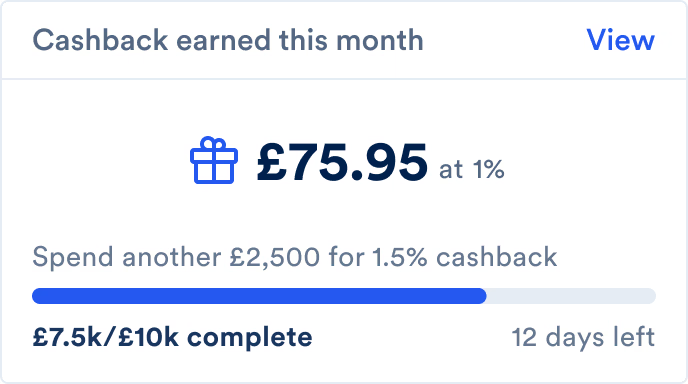
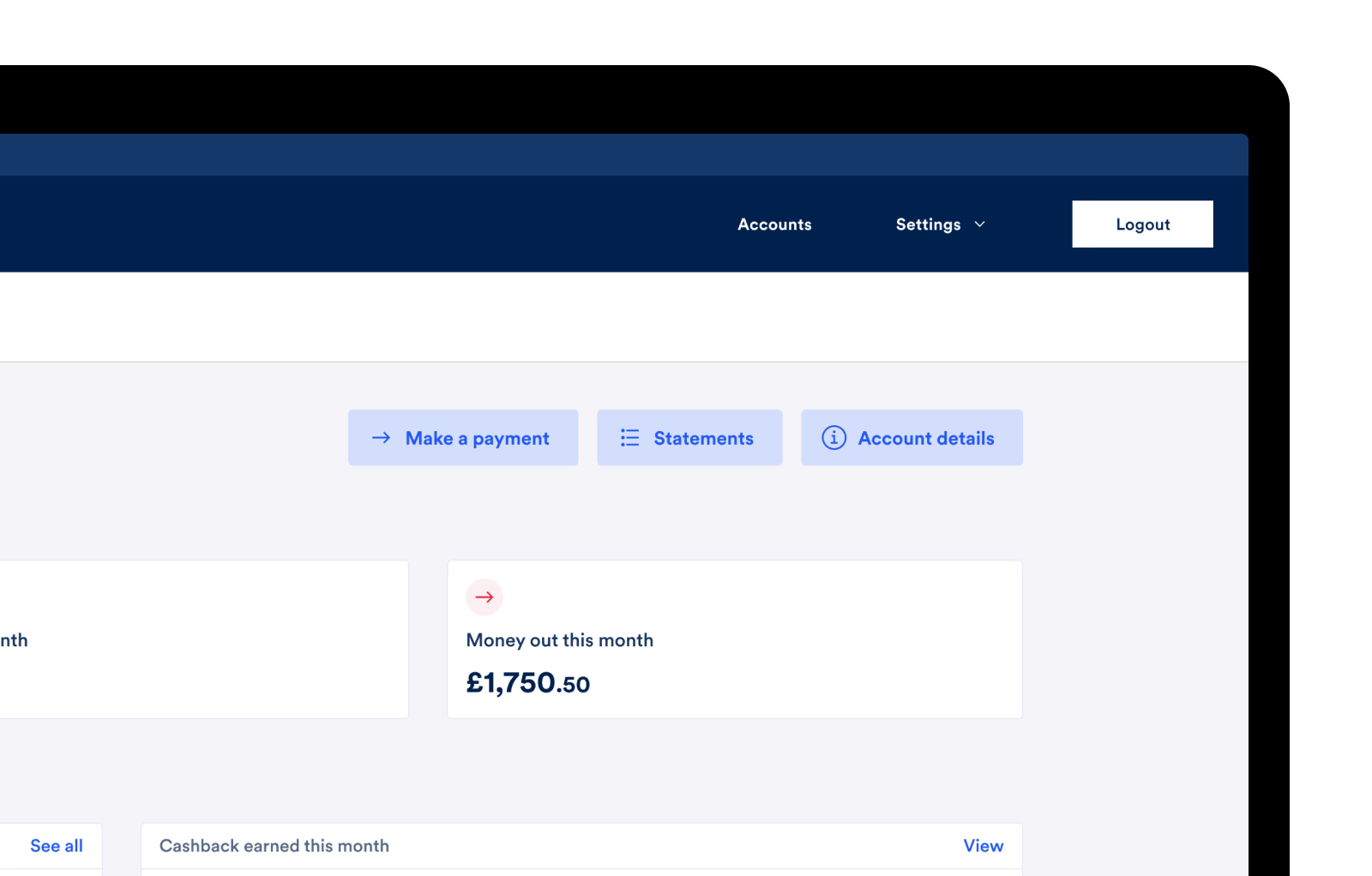
Quick actions for faster access to common tasks
A strong foundation for future iterations
This design balanced immediate customer needs with technical feasibility, creating a foundation that can be built on in future iterations.
Testimonials
“Khayam was a great asset to the Allica Bank Payments squad. Working on an array of new product features, and contributing to the new, overall design system, khayam had a solid understanding of UX / UI design, and was willing to openly work alongside engineering to come to conclusions quickly but effectively. I’d happily recommend Khayam to any engineering team going forward.”
Andrew McCulloughLead Engineer, Allica Bank